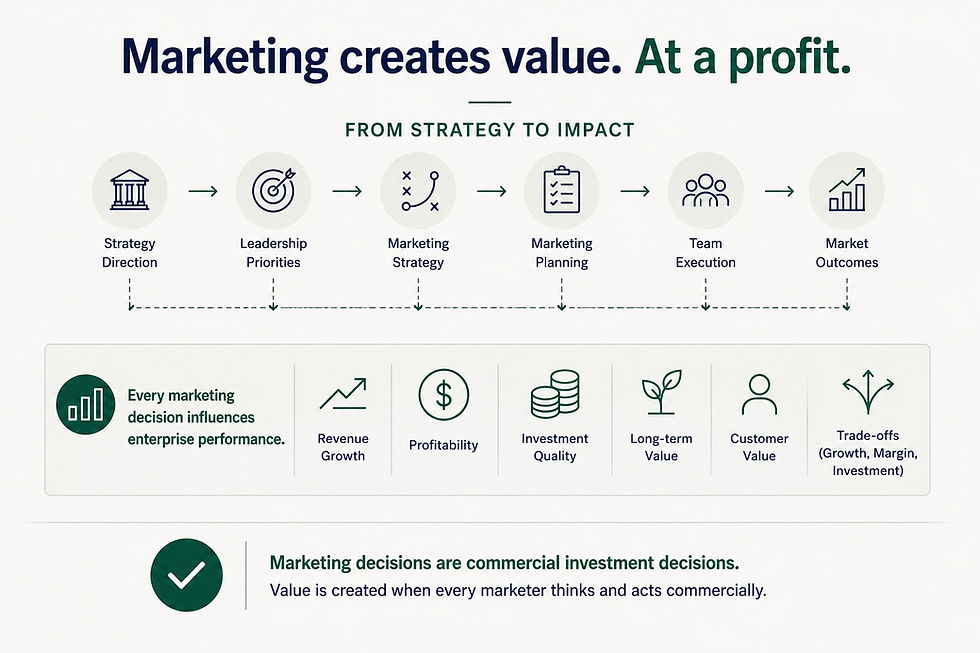
Why Strategic Judgement Matters More Than Ever in Marketing Leadership
Marketing leaders have never had greater access to information. Customer behaviour can be tracked in real time, performance can be monitored across multiple dimensions, and advances in technology continue to expand the volume and accessibility of market intelligence available to decision-makers. At the same time, organisations have access to an unprecedented range of growth opportunities, from new markets and customer segments to emerging technologies, partnerships, products, and business models.
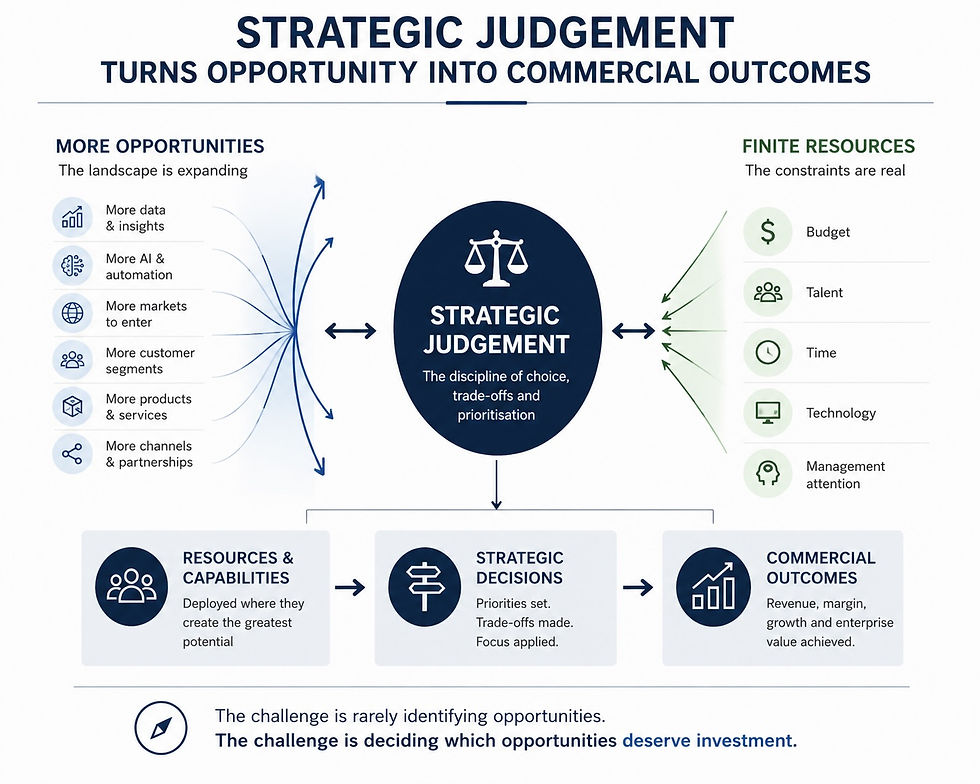
One might assume that more information and more opportunity would make decision-making easier. In reality, the opposite is often true. As the number of potential opportunities expands, so too does the complexity of choosing between them. The challenge facing many marketing leaders today is therefore not a shortage of options, but the need to determine which options deserve investment, attention, and organisational commitment.
This is where strategic judgement becomes increasingly important.
The Challenge Is No Longer Access to Information
While marketing is often associated with execution, performance, and growth, many of the outcomes organisations seek to achieve are shaped long before a campaign is launched or a budget is approved. They are influenced by a series of choices about where resources should be allocated, which capabilities should be strengthened, which markets should be prioritised, and which opportunities should be pursued.
Every strategic decision creates a path forward while simultaneously closing off alternative possibilities. Leadership therefore becomes less about generating ideas and more about deciding which ideas deserve commitment. As organisations gain access to more information and more opportunities, the ability to distinguish between attractive options and valuable options becomes increasingly important..
Strategic Judgement: Every Opportunity Carries a Trade-Off
The importance of these choices becomes even more apparent when viewed through the lens of resources and capabilities. Every organisation operates under constraints. Capital, talent, expertise, technology, management attention, and organisational capacity are all finite. The question is therefore not whether opportunities exist, but whether an organisation possesses the resources and capabilities required to pursue them successfully.
This introduces an often-overlooked reality of strategic management. Every decision to invest in one opportunity is simultaneously a decision not to invest elsewhere. Every priority creates a trade-off. Every allocation of resources influences the capabilities the organisation develops and the opportunities it can pursue in the future.
Strategic judgement provides the mechanism through which these trade-offs are evaluated and prioritised.
Commercial Outcomes Begin With Strategic Choices
As marketing's commercial accountability continues to increase, the quality of these decisions is becoming more visible. Boards and executive teams are placing greater emphasis on revenue quality, profitability, growth sustainability, capital efficiency, and long-term value creation.
These outcomes are ultimately reported through financial and operational measures, yet they originate in decisions that were made much earlier. Long before growth appears in a board report, strategic judgement has influenced where resources were invested, which capabilities were developed, and which opportunities received attention.
Revenue, profitability, and growth are often treated as the results of marketing activity. In reality, they are frequently the consequences of a series of strategic choices that determine how effectively an organisation creates and captures value.
The Missing Discipline in Marketing Leadership
This is perhaps why strategic judgement deserves greater attention within marketing leadership. The profession has invested heavily in developing expertise in customer understanding, brand development, communications, digital channels, analytics, and technology. These capabilities remain essential. Yet their value is ultimately realised through the quality of the strategic decisions that guide their application.
The strongest marketing leaders are rarely distinguished by the volume of activity they oversee. They are distinguished by their ability to evaluate competing opportunities, balance short-term and long-term priorities, assess risk, and allocate resources where they are most likely to create value.
In many respects, strategic judgement is the discipline that connects resources and capabilities to commercial performance.
The Leadership Capability That Shapes Future Value
As organisations face increasing complexity, expanding opportunity, and growing commercial accountability, strategic judgement is becoming one of the most important leadership capabilities a marketer can possess.
Information remains valuable. Insight remains valuable. Technology remains valuable. Yet competitive advantage increasingly depends on the quality of the decisions organisations make with them.
Because while commercial performance is ultimately measured through revenue, profitability, and growth, those outcomes are often shaped by choices made long before the numbers appear. Strategic judgement is what determines which opportunities receive attention, which capabilities are developed, and how scarce resources are transformed into future value.
Schedule a Conversation to discuss the Strategic Marketing Value System™ >