The Financial Credibility Gap in Marketing
Boards are asking increasingly demanding commercial questions of marketing leadership.
How efficiently is growth being generated? Which customer segments create the highest long-term profitability? How does brand investment influence pricing power, margin resilience and long-term enterprise value? Which markets, products and customer portfolios justify the strategic investment to generate sustainable, profitable growth?
These are no longer questions that sit exclusively within finance. They increasingly sit at the centre of strategic marketing leadership.
Yet many marketing development pathways were established during a period when the profession operated within a narrower commercial remit. Marketing capability development traditionally concentrated on customer understanding, communications, positioning, branding and demand generation, while financial accountability, capital allocation and enterprise performance remained more heavily associated with finance and executive leadership functions.
That division is becoming increasingly difficult to sustain.

The Expansion of Marketing’s Commercial Mandate
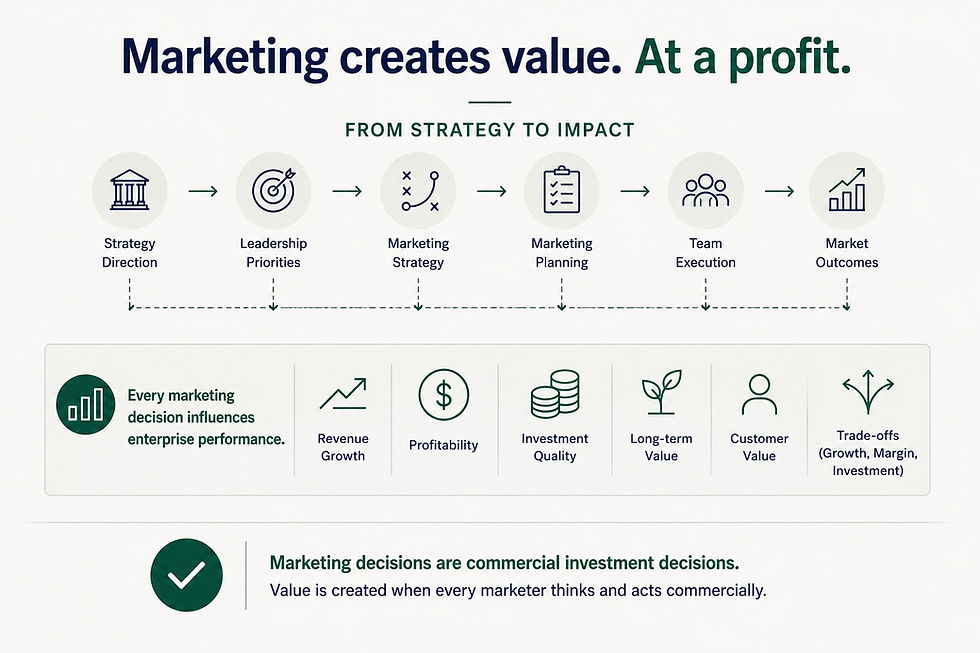
Marketing now materially influences revenue quality, margin performance, pricing power, customer profitability, growth sustainability and shareholder confidence. As marketing’s influence over enterprise performance has expanded, expectations from boards, CEOs and CFOs have evolved alongside it.
Recent industry data reflects the scale of this transition:
Only 21% of marketers report complete alignment with CFOs on budgets and metrics.*
62% say they require stronger tools to demonstrate marketing’s contribution to business performance and profitability.*
63% report increasing pressure from CFOs to prove financial impact.*
59% report increasing pressure from CEOs to demonstrate marketing’s value.**
45% report increasing pressure from boards to demonstrate commercial contribution.**
The implications extend far beyond reporting mechanics.
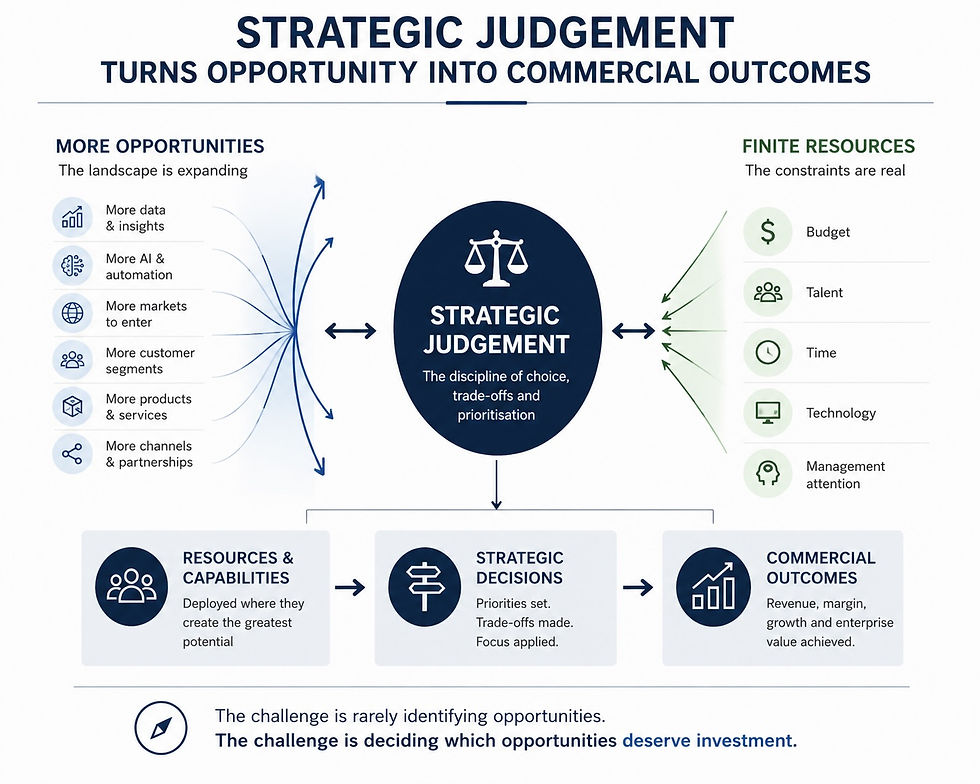
Many organisations still operate with fragmented performance frameworks in which marketing evaluates customer and growth performance, finance evaluates financial performance and strategy evaluates long-term growth ambition. Boards and executive teams are increasingly required to reconcile these separate perspectives into a coherent view of enterprise value creation, often without a unified system capable of integrating them effectively.
This creates structural challenges across investment evaluation, strategic prioritisation, resource allocation and long-term growth planning. Customer metrics, financial metrics and strategic objectives frequently operate in parallel rather than through an integrated enterprise performance model, limiting visibility into how marketing investment influences profitability, growth quality, resilience and long-term value creation.
The Structural Gap Between Marketing and Finance
The issue therefore is not simply whether marketers possess stronger financial literacy.
The deeper issue is that many organisations still lack an enterprise-wide framework capable of systematically connecting customer strategy, market growth, brand investment, product portfolio decisions and financial performance into a unified model of strategic management.
Finance has long operated through mature systems of governance, accountability, capital management and value measurement. Marketing, by contrast, often continues to operate through fragmented tactical and operational performance structures despite its growing influence over enterprise outcomes.
This increasingly creates tension between:
Customer value and commercial value
Growth investment and profitability
Brand development and financial accountability
Short-term performance and long-term enterprise value
As executive scrutiny increases, the absence of integrated marketing value systems becomes increasingly visible.
Financial Credibility Gap in Marketing: Why Traditional Marketing Metrics Are Becoming Insufficient
Many organisations continue to evaluate marketing primarily through operational and channel-level indicators such as campaign efficiency, engagement, acquisition performance and lead generation.
While these metrics remain operationally important, they rarely provide boards with a sufficiently integrated view of:
Profitable growth
Margin contribution
Capital efficiency
Customer economics
Strategic resilience
Long-term value creation
This is one reason many marketing leaders experience growing pressure from CFOs and boards despite increased sophistication in analytics and performance reporting.
The issue is often not the absence of data.
It is the absence of a unified strategic framework capable of translating marketing activity into enterprise-level commercial outcomes.
The Next Phase of Marketing Leadership
The next evolution of marketing leadership is unlikely to be defined solely by channels, platforms or communications capability. It will increasingly be defined by the ability to connect customer value, strategic growth, financial performance and enterprise strategy into a coherent system of long-term value creation.
The organisations that achieve this integration most effectively will likely create stronger alignment between marketing, finance, strategy and executive leadership than many businesses operate with today.
That shift has the potential to fundamentally reshape how marketing contributes to enterprise performance. And over time, it may redefine how the profession itself is understood at board level.
The Importance of Enterprise Marketing Systems
This is where the Strategic Marketing Value System® becomes increasingly relevant in closing the financial credibility gap in marketing.
Instead of separating customer strategy, brand management, market growth, profitability and strategic planning into isolated disciplines, the framework connects them into a unified model aligned around enterprise performance and long-term value creation.
Within this model, marketing becomes:
A strategic performance function
A driver of enterprise value
A system for profitable growth management
A structure for cross-functional alignment
A governance mechanism for strategic decision-making
This changes how marketing contribution is evaluated.The conversation moves beyond campaign activity and operational metrics toward:
Revenue quality
Customer profitability
Growth efficiency
Capital allocation
Strategic prioritisation
Long-term enterprise performance
Importantly, this does not diminish the importance of customer-centricity or brand leadership. It strengthens them by integrating them more directly into enterprise decision-making and commercial accountability.
Schedule a Conversation to discuss the Strategic Marketing Value System™ >