Marketing Profit: What Happens When Every Marketer Thinks Commercially?
Philip Kotler famously defined marketing as:
“The science and art of exploring, creating, and delivering value to satisfy the needs of a target market at a profit.”
At a profit.
It remains one of the most important definitions in marketing because it connects customer value directly to commercial performance. Marketing exists to create value for customers in a way that also creates sustainable enterprise value for the business.
Yet as organisations grow, scale, and operationalise strategy across teams, functions, systems, agencies, markets, and performance structures, that original definition often becomes increasingly difficult to embed consistently throughout everyday decision-making.
Marketing teams become highly capable in campaign execution, channel management, optimisation, engagement, lead generation, reporting, and performance activity. At the same time, marketing’s influence on enterprise performance continues to expand significantly.
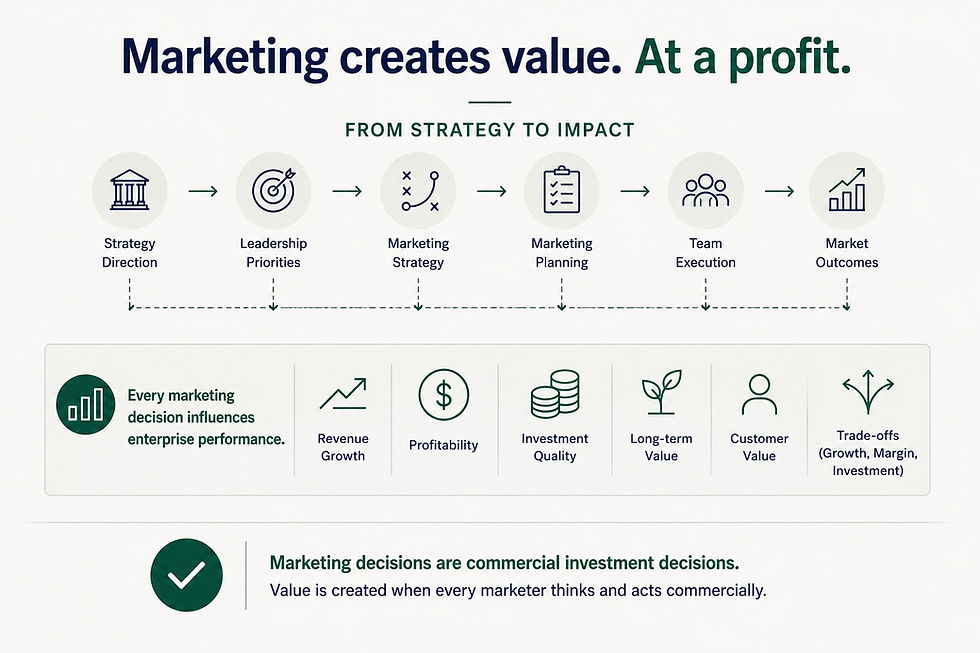
Today, marketing directly influences:
Revenue growth
Profitability
Customer value
Investment quality
Growth sustainability
Capital allocation efficiency
Strategic positioning
Commercial risk
Increasingly, marketing decisions shape enterprise outcomes far beyond communications activity alone.
Every Marketing Decision Contains Commercial Trade-Offs
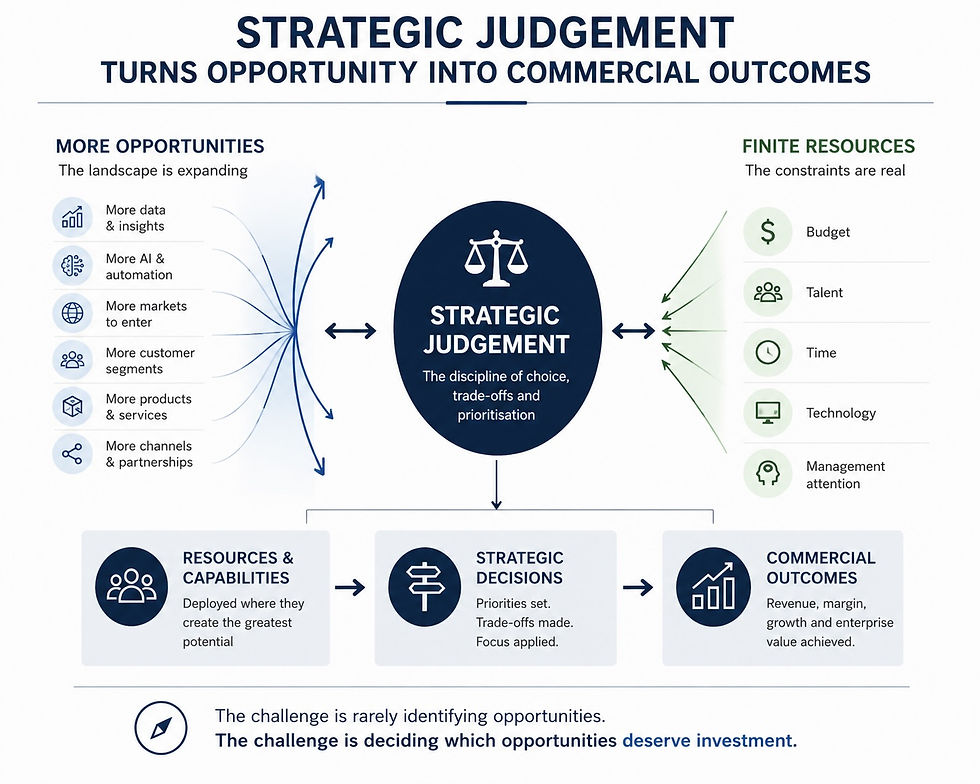
Marketing strategy continuously involves decisions between competing priorities. These are not simply marketing choices. They are commercial investment decisions.
Every decision shapes how resources are allocated, how value is prioritised, how growth is pursued, and how enterprise performance evolves over time.
This changes the role of marketing fundamentally.
The challenge is no longer simply executing activity efficiently. Increasingly, the challenge becomes ensuring that marketing decisions consistently align with enterprise value creation across the organisation.
The Gap Between Marketing Activity and Enterprise Value
Many organisations already communicate strategic priorities clearly.
· Growth targets are defined
· Financial objectives are established
· Customer ambitions are articulated
· Commercial goals are agreed at leadership level.
Yet strategy rarely moves through an organisation unchanged.
As strategy filters through planning cycles, KPIs, reporting structures, departments, agencies, optimisation pressures, market realities, and execution teams, interpretation naturally enters the system.
In many cases, this happens because modern marketing environments are increasingly complex, commercially pressured, and highly distributed across multiple functions, technologies, specialisms, and performance systems.
The result is that marketing activity can remain highly productive while enterprise value creation becomes less consistently connected throughout the wider system.
Marketing Decisions Increasingly Shape Enterprise Value and Profit
Imagine if every marketer consistently evaluated decisions through a broader commercial lens.
Not only asking:
Will this campaign perform?
Will engagement increase?
Will acquisition improve?
But also asking:
How does this influence revenue quality?
What is the profitability implication?
Does this strengthen long-term customer value?
Is this the strongest investment decision?
What strategic trade-offs are being made?
How does this contribute to sustainable growth?
This is where marketing begins operating differently.
Marketing evolves from a function primarily measured through activity into a function increasingly connected to enterprise value creation.
That does not diminish creativity, customer understanding, or brand building. It strengthens them by connecting marketing decisions more directly to long-term commercial performance.
Embedding Value Throughout the Marketing System
This becomes possible when value is explicitly embedded throughout the marketing system itself.
The organisations likely to create the strongest long-term outcomes increasingly understand that value creation requires more than isolated campaigns, disconnected metrics, or short-term optimisation.
It requires a connected system that helps guide how decisions are evaluated, prioritised, interpreted, and aligned across the marketing function.
Because if marketing is fundamentally about creating value at a profit, every marketer should understand how their decisions contribute simultaneously to:
Revenue
Profitability
Customer value
Investment quality
Strategic growth
This is where marketing increasingly becomes more than a communications or activity function.
It becomes an enterprise value system.
Schedule a Conversation to discuss the Strategic Marketing Value System™ >