Resources and Capabilities in Marketing Leadership: Creating Commercial Value
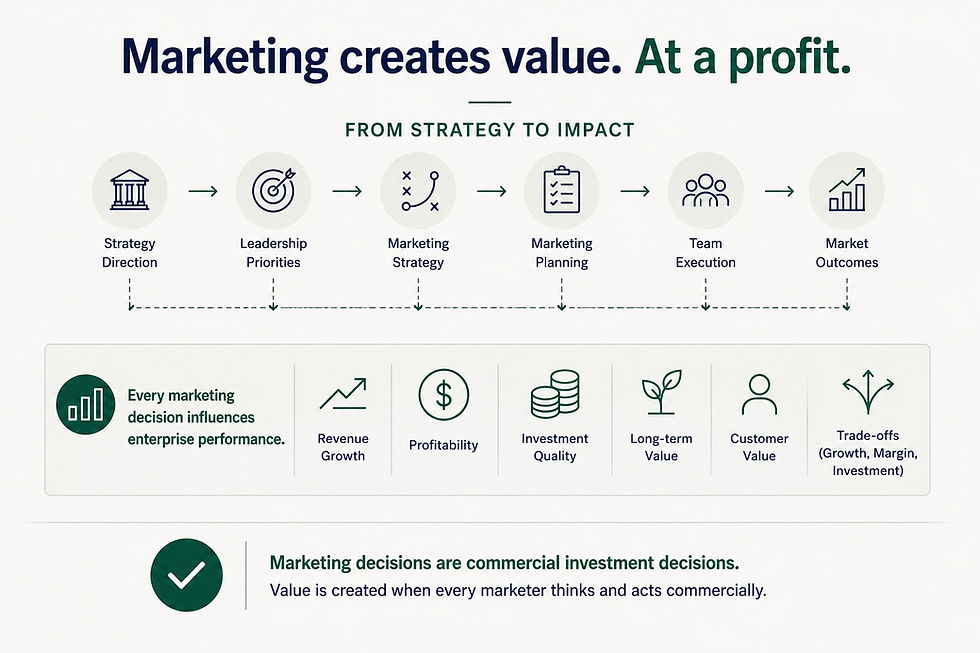
As marketing's commercial accountability continues to increase, there is a growing focus on measures such as revenue, margin, profitability, and return on investment.
This evolution reflects a broader shift in how organisations view marketing.
Marketing leaders are increasingly expected to contribute to discussions about growth, investment priorities, resource allocation, competitive position, and long-term value creation. The role is becoming more commercial, more strategic, and more closely connected to enterprise performance.
Yet as organisations become more focused on outcomes, an important question emerges. What determines an organisation's ability to achieve those outcomes in the first place? The answer often lies in resources and capabilities.
While the concept has been a cornerstone of strategic management for decades, it receives surprisingly little attention within marketing leadership discussions. Yet it provides one of the most useful lenses through which to understand how organisations create value and sustain competitive advantage.

Looking Beyond Performance Measures
Measures such as revenue, profitability, market share, customer value, and return on investment are essential. They help leaders evaluate performance and assess whether strategic decisions are delivering the intended results.
However, they are outcomes. They tell us what has happened. Resources and capabilities help explain why.
Two organisations can operate in the same market, pursue similar growth ambitions, and invest comparable amounts of money, yet achieve very different results. The explanation often lies in the quality of their resources and capabilities and how effectively they are deployed.
This distinction is important because it shifts leadership attention from performance measurement alone towards the conditions that make performance possible.
What Are Resources and Capabilities?
Resources represent the assets available to an organisation. These may include:
Talent and expertise
Data and information
Technology platforms
Financial capital
Intellectual property
Brand equity
Customer relationships
Distribution networks
Partnerships and alliances
Capabilities are different. Capabilities represent an organisation's ability to deploy, combine, and utilise those resources effectively.
Customer insight generation is a capability.
Strategic planning is a capability.
Portfolio management is a capability.
Innovation is a capability.
Brand development is a capability.
Pricing management is a capability.
The distinction matters because resources alone rarely create value. Value emerges through the organisation's ability to transform resources into meaningful capabilities that support strategic objectives.
Why This Matters for Marketing Leaders
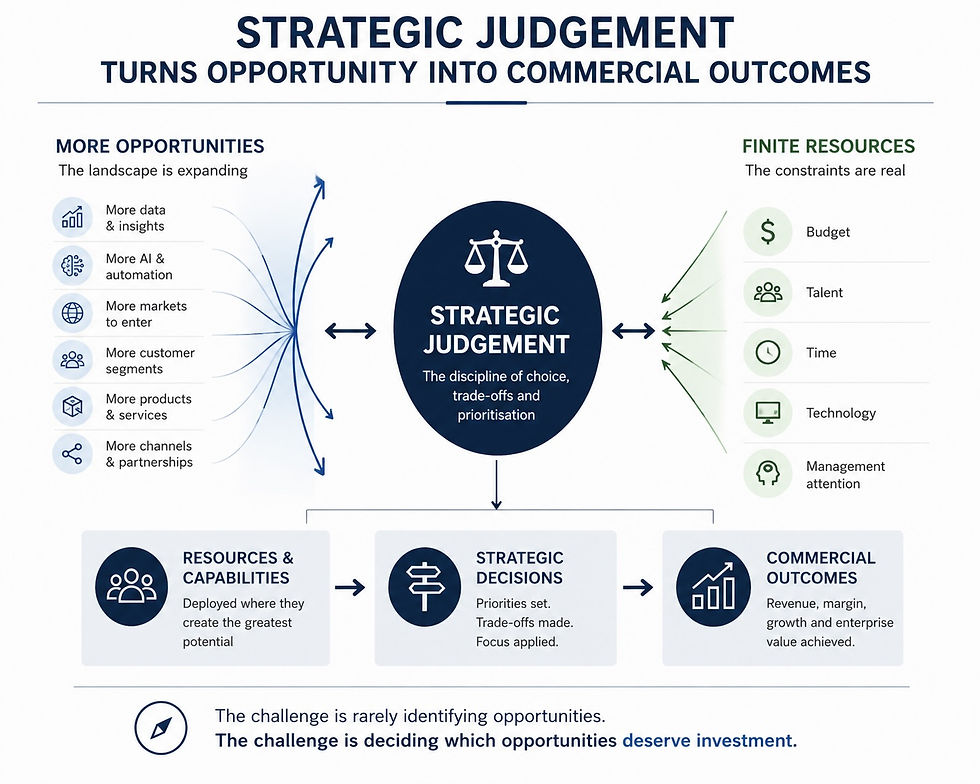
Every marketing leader operates under conditions of resource scarcity.
Budgets are finite.
Talent is finite.
Management attention is finite.
Time is finite.
Technology investment choices are finite.
As a result, leadership becomes an exercise in prioritisation.
Which customer segments deserve greater investment?
Which capabilities should be strengthened?
Where should resources be concentrated?
Which opportunities should be pursued?
Which trade-offs create the greatest long-term value?
These questions sit at the heart of strategic management because they influence the organisation's future ability to compete, adapt, and grow. Marketing leaders make these decisions every day, whether consciously or unconsciously.
The Link Between Resources, Capabilities, and Commercial Value
One of the reasons resources and capabilities create such an immediate shift in perspective is that they provide a bridge between activities and outcomes.
Marketing often becomes absorbed in campaigns, channels, programmes, and initiatives.
Resources and capabilities encourage leaders to step back and ask a different question. What organisational capability is this investment strengthening?
A customer insight programme may strengthen decision quality.
Investment in brand may strengthen pricing power and customer preference.
Investment in marketing technology may strengthen execution and measurement.
Investment in talent may strengthen innovation and strategic judgement.
Each decision influences the organisation's future ability to create value. Viewed through this lens, marketing investment becomes far more than an exercise in budget management. It becomes a deliberate process of building the capabilities required to support future performance.
A Strategic Management Perspective
Resources and capabilities are often discussed within the context of strategy because they help explain why some organisations consistently outperform others.
Competitive advantage rarely emerges from a single campaign, product launch, or tactical initiative. It develops through the accumulation of capabilities that competitors find difficult to replicate.
The organisations that understand their resources, invest deliberately in capability development, and align those capabilities with strategic priorities often place themselves in a stronger position to create sustainable value over time.
For marketing leaders, this perspective offers a powerful shift.
It moves the conversation beyond activity and towards strategic capacity. Beyond short-term performance and towards long-term value creation. Beyond what marketing does and towards what marketing enables the organisation to become.
Resources and Capabilities in Marketing Leadership: Creating Commercial Value
As marketing's commercial accountability continues to grow, resources and capabilities may become one of the most important concepts marketers can understand.
Because while revenue, profitability, and growth remain essential measures of success, resources and capabilities often determine whether those outcomes can be achieved in the first place.
Schedule a Conversation to discuss the Strategic Marketing Value System™ >