Why Marketing Fails at Enterprise Level
Updated: Mar 12
Most organisations expect marketing to contribute to growth, competitive differentiation, and long-term enterprise value, yet few structure it to operate at that level.
Across many businesses, marketing remains positioned as an executional function — accountable for campaigns, channels, and communications, while strategic direction, capital allocation, and risk trade-offs are governed elsewhere.
Activity increases. Outputs improve. Yet leadership confidence in marketing-led decisions remains inconsistent. This disconnect reflects a structural gap rather than a capability gap.

The Structural Constraint that Makes Marketing Fail at Enterprise Level
Enterprise-level contribution requires more than performance metrics. It requires governed strategic judgement.
When marketing operates without an explicit value logic:
Priorities become difficult to compare
Trade-offs lack financial transparency
Investment debates revert to precedent or persuasion
Short-term indicators dominate complex growth decisions
Boards and CEOs seek clarity on how customer-led growth translates into profitable return. When that translation mechanism is absent, marketing influence fragments.
Execution continues, yet authority remains constrained.
Elevate Marketing by Addressing Three Leadership Questions
A strategic marketing system resolves why marketing fails at enterprise level, by embedding clear answers to three strategic questions:
1. What Value Is Marketing Accountable For Creating?
Value must be defined in commercial terms — growth quality, margin contribution, capital efficiency, and customer lifetime impact.
2. How Are Strategic Decisions Evaluated and Prioritised?
Initiatives require disciplined criteria that integrate customer insight, market dynamics, financial return, and risk exposure.
3. How Is Performance Governed in Line with Enterprise Objectives?
Dashboards, reporting structures, and review processes must align directly with board-level goals and capital stewardship.
When these questions are structurally embedded, marketing becomes measurable in enterprise terms rather than activity terms.
From Delivery Function to Decision Capability
Marketing succeeds at enterprise level when it is designed as a system of:
Explicit value creation
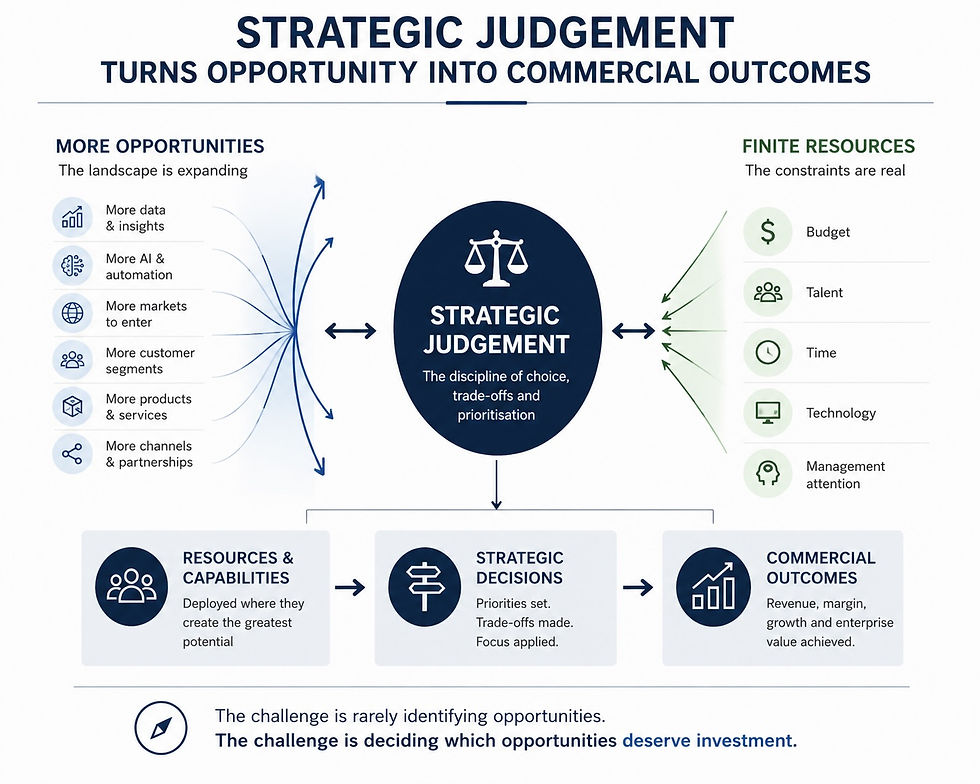
Disciplined strategic judgement
Visible governance
When designed as a system rather than simply a function, marketing informs strategic direction, strengthens capital allocation, and supports leadership confidence across the organisation. In other words, the shift is architectural.
Marketing transitions from a collection of initiatives to a governed enterprise capability, one that shapes growth strategy, guides investment decisions, and contributes predictably to long-term value creation.